Capoeira
History - Practising - Benefits
History of CapoeiraCapoeira is an Afro-Brazilian artform where
martial-arts, dance, acrobatics, music, creativity and ingenuity come together.
The origins of capoeira are found in the times of slavery in Brazil. The slavery
started growing in the 17th century when the Portuguese shipped Africans to
work for them as slaves in Brazil. In Africa there existed dances, martial-arts
and music that the Africans brought along to Brazil, together with their cultures
and religions. These components all mixed in Brazil. With the passing of time,
slaves and ex-slaves develloped capoeira at different places in Brazil. You
can say that without African influence there would be no capoeira in Brasil
today as we know it, but that in Brazil all the African influences together
with other influences have blended into what we now consider capoeira. Since
then capoeira develloped itself at different locations and does not stem from
one person who one day created capoeira and registered it. Nowadays there
are many variations to be found in Brazil together with other cultural expressions
which also contain African roots. Capoeira also became folcore of Brasil with
traditions emerging over time who are now maintained by a number of masters.
Capoeira is an art where creativity is a way to deal with several things happing
in the art. This has led to many adjustments and variations over time, many
of which are (re)-invented over time, based on the taste and experience of
it's practisioners. For an understanding of these adaptations, an understanding
of the position of capoeira and it's practisioners over time, is essential.
There is no clear date known which marked the beginning of the first capoeira
beeing praticed and even now capoeira is still changing.
Nowadays capoeira has expanded a lot leading to various different lineages
with there own selection of rules, style, ethics etc. A number of masters
have helped capoeira grow and transform in the past century. They left their
lessons and Filosophy with the newer generations who maintain these traditions,
now and then adding or changing components based on their experience, judgement
and taste. Within capoeira several groups value the research of capoeria traditions,
but many schools also spend time trying to innovate capoeira in many ways.
Capoeira has been persecuted in Brazil and could only be practised for a long time in secret. Nowadays due to the effort of several people capoeira is practised out in the open and is asked to contribute to commercials and videoclips mostly due to it's spectaculair dynamic aspects. Several campaigns and projects in Brazil have contributed to the further integration of capoeira in the Brazilian society and it is now to be found at al kinds of locations within Brazil and the rest of the world, like community centers, universities, gyms etc. Not only the number of movements, the expansion of songs but also it's diffusion around the world and the strong growth of capoeira practisioners have changed the position of capoeira permanently.
A big number of masters have contributed to capoeira, making
it possible for the current state of development beeing where it is at. Naming
al of these masters and contributions is not possible but a few masters (that
already passed away) will be cited below.
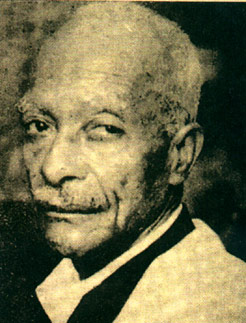
| Mestre Pastinha (1889-1981)
This master is seen as one of the most important representatives
and preservers of a capoeira stijl that is nowadays called, Capoeira
Angola. He gave lessons for years, wrote a book, recorded an LP and
is know for his capacity within capoeira and his philosphy that he was
able to express in poetry. |
 |
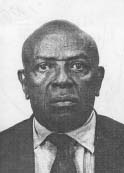
Mestre Bimba (1899-1974) This master is the creator of a capoeira style nowadays
called Capoeira Regional. |
 |
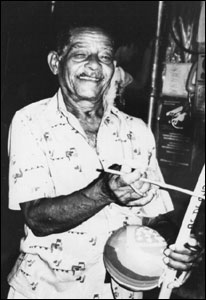
Mestre Waldemar (1916-1990) This master held a roda (capoeira circle) for years
each sunday in the Liberdade neighbourhood of Salvador. He was famous
for the level of his roda and his singing capacity, having knowledge
of various songs that talked of life and it's lessons.
|
 |
|
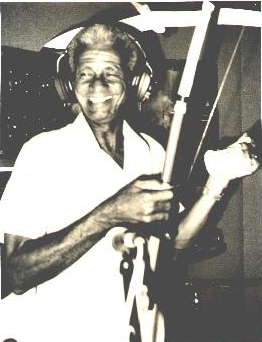
Mestre Canjiquinha (1925-1994) For many years this master gave lessons and shows in Bahia. A master who knew a huge number of songs and did not only knew capoeira, but maculelê, samba de roda and puxada de rede as well (all folcloric expression of Brazil). These he inclued in his shows which helped establish a connection between the four components. He created own rhythms on the berimbau, wrote a book, recorded an LP together with Mestre Waldemar. Because of his connections with public relations and his outgoing talent he appeared several times in movies in the sixties demonstrating capoeira. (Barravento, Capitães de Areia and Pagador de Promessas for example). A few students who trained with him or people that where influenced by him are: Mestre Geni, Mestre Paulo dos Anjos, Mestre Edvaldo Baiano, Mestra Cigana, Mestre Brasiliá and Mestre Suassuna. |
 |